
From East St. Louis classrooms to research labs and manufacturing floors, a growing network of educators, nonprofits, and employers is building the talent pipeline powering the region’s bioscience economy.
Where will St. Louis’ next generation of talent come from? For leaders across the bioscience ecosystem, the answer starts early.
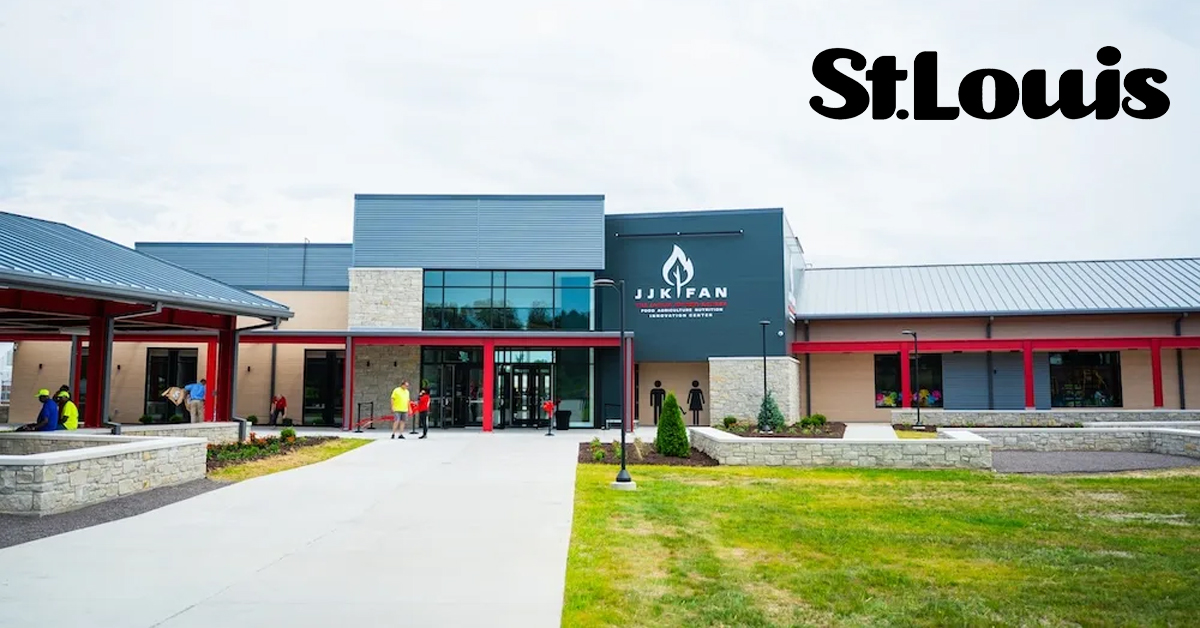
Today, the Jackie Joyner-Kersee Foundation is celebrating the grand opening of the JJK FAN (Food, Agriculture and Nutrition) Innovation Center in East St. Louis. Developed through a partnership between the Jackie Joyner-Kersee Foundation, the Donald Danforth Plant Science Center, the University of Illinois System, and Lansdowne UP, the center will provide hands-on learning experiences in agriculture, nutrition, and STEM fields while introducing students to career possibilities they may not otherwise encounter. The facility includes teaching laboratories, greenhouse space, and educational programming designed to connect classroom concepts with real-world applications.
“I want our students to pursue these opportunities and feel confident that they’re invited to that table,” says Amy Funk, director of the center. By high school, she adds, many students have already formed ideas about what they can and cannot become. Early exposure can help expand those possibilities before those assumptions take hold.
In fact, research suggests that children begin forming ideas about whether science is “for them” during their earliest school years. At the Donald Danforth Plant Science Center, that understanding has shaped a growing focus on students in kindergarten through eighth grade, with particular attention to the K-3 years, when interest in science and perceptions about who belongs in the field often begin to take shape.
“The kids who are scientifically minded need to be encouraged in that when they’re young,” says Giles Oldroyd, president of the Danforth Center. “They need to be stimulated in it, and they need to see themselves as potential scientists.”
The goal extends beyond sparking curiosity. Leaders hope that early exposure will help students build confidence in science and continue pursuing it as they move through school.
“If you’re having a hard time with math, you are likely not thinking about wanting to further pursue STEM,” says Brittany Whitley, director of regional workforce strategy at BioSTL. “It creates a barrier. Well, I’m not good at math; therefore, I’m probably not a science person.”
Those assumptions can quietly narrow opportunities years before students begin exploring college majors or careers.
“We graduate these people in St. Louis who are really talented, but they don’t really fully appreciate all that they can do while they’re here.”
Building the Pipeline
Inspiring future scientists is only one piece of the workforce puzzle, though. From elementary school classrooms and workforce training programs to research institutions and global companies, a growing network of partners is building pathways into bioscience careers.
According to BioSTL’s forthcoming labor market analysis, roughly 40 percent of bioscience jobs in the St. Louis region are middle-skill positions that do not require a four-year degree. Many are concentrated in biomanufacturing, in which companies employ production operators, quality specialists, maintenance technicians, and equipment operators alongside scientists and engineers.
“Biotech usually has large, complex equipment,” Whitley says. “The people who know how to run, operate, and fix those sorts of machinery are extremely important.”
The industry’s workforce needs also extend beyond technical roles, encompassing everyone from project managers and compliance specialists to communications and human resources professionals. Many of those jobs require specialized training but not necessarily a bachelor’s degree.
At BRDG Park, a bioscience research and innovation campus within the 39 North AgTech Innovation District, St. Louis Community College’s Center for Plant and Life Sciences trains students for careers in biotechnology and laboratory science. Established in 2006 in response to industry demand, the program works closely with regional employers to align coursework with workforce needs, giving students hands-on experience with the same types of equipment and techniques they will encounter on the job.
Since moving to BRDG Park in 2009, the center has secured just over $4 million in external funding to equip its laboratories with industry-standard technology. The goal is to ensure graduates leave with the skills regional bioscience employers are already looking for.
Located alongside startups and research organizations on the Danforth Center campus, the center also connects students with internships and employment opportunities throughout the bioscience ecosystem.
“Seeing industry scientists working in our lab environments—and having opportunities to interact with them—helps students understand workplace expectations and observe how science is practiced outside the classroom,” says Elizabeth Boedeker, district director for the Center for Plant and Life Sciences at St. Louis Community College.
Those connections often lead directly to internships and jobs. Companies throughout BRDG Park and the nearby Helix Center regularly hire student interns. According to the latest available data, the program’s graduate placement rate exceeds 90 percent.
Even with strong training programs in place, workforce leaders say the handoff between education and employment remains one of the region’s biggest challenges. Many graduates complete degrees or certificates without fully realizing the range of opportunities available within the region’s bioscience ecosystem, Whitley says. Others assume they need to leave St. Louis for established biotech centers such as Boston, the Bay Area, or Research Triangle Park.
“We graduate these people in St. Louis who are really talented, but they don’t really fully appreciate all that they can do while they’re here,” Whitley says.
““I had no idea there was an ecosystem here. I think it’s one of St. Louis’ best kept secrets—and it shouldn’t be a secret.”
A Second Path Into Science
Not every future bioscience worker follows a traditional path.
At the Danforth Center, the Pivot to Plants Fellows Program was created for adults interested in careers in plant science, imaging, data science, and related STEM fields who may have limited research experience. The yearlong fellowship allows participants with associate or bachelor’s degrees to work directly alongside scientists while learning emerging technologies and research methods.
Among the program’s first participants was Tess Rogers, who spent nine years as a naturalist and educator at the World Bird Sanctuary before joining Bayer, one of the region’s largest agtech employers, as a biologist.
Rogers had studied ecology and conservation, but after nearly a decade in animal care and environmental education, she worried she had been out of research too long to find her way back. A volunteer at the sanctuary sent her a link to Pivot to Plants, and she kept returning to it.
“I don’t know. I’m not really that much of a plants person,” Rogers recalls thinking at first. “But the more I looked at it, the more I realized the program was exactly the kind of thing I was looking for.”
The fellowship introduced her to plant science, data tools, research culture, and the network of companies and organizations clustered around 39 North. It also revealed an industry she had not realized was growing around her.
“I had no idea there was an ecosystem here,” Rogers says. “I think it’s one of St. Louis’ best kept secrets—and it shouldn’t be a secret.”
Today, Rogers works in Bayer’s contained-environment group, supporting research teams by collecting plant samples and helping manage greenhouse work tied to studies across the company. Without Pivot to Plants, she says, she probably would not be working in plant science at all.
“I would have been too discouraged to get back into the research field,” she says. “And now that I’m in it, I’m so happy to be back.”
For Rogers, the fellowship provided a way to enter the field without stepping away from the workforce for years to pursue another degree.
“One of the biggest barriers we continue to see is, ‘I have this current job, I can’t afford to quit that job and do this training to get a different role,’” Whitley says.
As a result, apprenticeship programs, short-term certifications, and other earn-and-learn models have become a growing focus across the region.
The strategy is helping employers address workforce needs, but for many companies, the challenge extends beyond filling open positions.
“St. Louis has a fantastic offer right now. We’ve got a thriving ecosystem already, but I think we can grow it a lot.”
The Ecosystem Advantage
As St. Louis competes with established biotech hubs such as Boston, the Bay Area in San Francisco, and Research Triangle Park in North Carolina, employers are also working to attract talent from outside the region. Candidates considering a move often want to know not only about a specific job, but about the broader ecosystem surrounding it.
Whitley says prospective recruits might ask, “What other biotech do you have? If I lose my job or if something happens, where else can I go?” Workers are often evaluating not only a company but also an ecosystem, including whether there will be opportunities to grow, change jobs, and build a career over the long term.
For large employers, those ecosystem questions are becoming increasingly important in recruiting. That dynamic is especially important for MilliporeSigma, one of the region’s largest bioscience employers. The company employs roughly 2,400 people in the St. Louis area across research, manufacturing, and related functions.
Over the past five years, MilliporeSigma has invested more than $250 million in its St. Louis operations. In 2025, it expanded its long-standing partnership with WashU, a collaboration aimed at accelerating research, supporting entrepreneurship, and strengthening the region’s life-science talent pipeline.
Looking ahead, employers say the region’s future growth will depend on continuing to strengthen the workforce pipeline.
“The biggest impact would come from expanding hands-on training, strengthening industry-academic partnerships and helping students see bioscience as more than a research career,” says Daniel Sherling, director of global social media and digital communications at MilliporeSigma. “The sector will need talent across labs, manufacturing, quality, engineering, and digital roles.”
The region’s ability to attract talent is already visible elsewhere in the ecosystem. Last year, Oldroyd left the University of Cambridge and moved from the United Kingdom to St. Louis to become president of the Danforth Center. He believes that the combination of world-class plant science, a growing agtech cluster, and affordability gives St. Louis a competitive advantage.
“St. Louis has a fantastic offer right now,” he says. “We’ve got a thriving ecosystem already, but I think we can grow it a lot.”
Growth, he argues, depends on both recruiting talent to St. Louis and creating opportunities for people already here.
“We won’t leave a scientist behind,” he says.